
Welcome to Nex Gen Publications
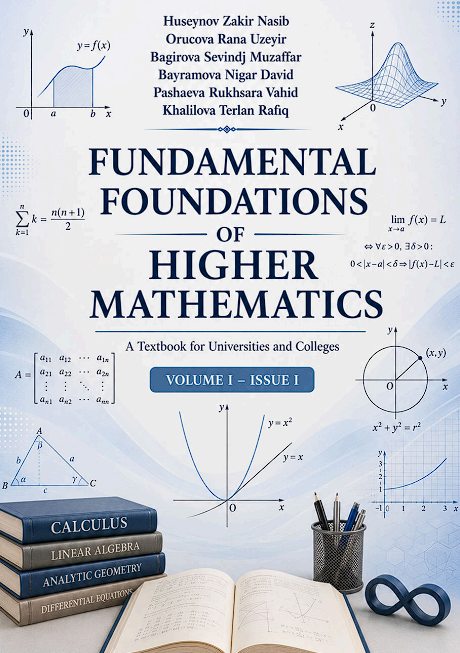
FUNDAMENTAL FOUNDATIONS OF HIGHER MATHEMATICS
Huseynov Zakir Nasib, Orucova Rana Uzeyir, Bagirova Sevindj Muzaffar, Bayramova Nigar David, Pashaeva Rukhsara Vahid and Khalilova Terlan Rafiq
Format
Paperback and e – book
ISBN
978-81-69295-14-7
DOI
doi.org/10.5281/zenodo.21738515
Pages
450 Pages
Price
Rs. 1000/- ( $80 )
Mathematics provides the conceptual language through which patterns, structures, quantities, and relationships can be described with precision. It is fundamental not only to the mathematical sciences but also to engineering, computer science, economics, physics, and many other fields that rely on logical analysis and quantitative reasoning. A sound understanding of higher mathematics therefore requires more than familiarity with formulas. It requires the ability to interpret definitions, recognize mathematical structures, justify procedures, and communicate conclusions accurately. Fundamental Foundations of Higher Mathematics: Volume I has been prepared as a bachelor’s degree textbook for students beginning their systematic study of university-level mathematics. Its principal purpose is to establish a coherent foundation in linear algebra, vector algebra, analytic geometry, and the introductory concepts of mathematical analysis. The material is organized to support the gradual transition from computational methods to abstract mathematical reasoning. The volume begins with matrices and determinants, which provide an efficient framework for representing linear relationships and transformations. Matrix operations, determinant properties, inverse matrices, rank, and related structural concepts are developed together with their computational applications. The study of systems of linear equations extends these ideas by examining consistency, uniqueness, elimination methods, and the interpretation of solutions through matrix structure. The treatment of vector algebra connects algebraic operations with geometric meaning. Vectors are introduced as mathematical objects representing magnitude and direction, followed by linear combinations, scalar and vector products, projections, and geometric applications. These concepts form the basis for the subsequent study of analytic geometry. The chapters on analytic geometry examine geometric objects through coordinate, vector, and algebraic methods. Lines and curves in the plane are studied before the discussion is extended to points, lines, and planes in threedimensional space. Particular attention is given to the relationship between equations and the geometric objects they represent. The study of quadric surfaces further develops this relationship by analyzing second-degree surfaces, their standard forms, classifications, coordinate transformations, and geometric properties. The later part of the volume introduces the language and foundational ideas required for mathematical analysis. Sets, real numbers, intervals, bounds, supremum, infimum, and related concepts are presented as essential tools for rigorous reasoning. Functions are then examined through their domains, ranges, graphs, classifications, transformations, and qualitative properties. The final chapter develops sequences, limits, and continuity, thereby establishing the conceptual basis for the subsequent study of differential and integral calculus. Throughout the textbook, computational techniques are presented together with their mathematical meaning. Definitions are stated carefully, formulas are accompanied by explanations of their notation and conditions, and procedures are developed in a logical sequence. Worked examples illustrate the application of general principles, while tables and diagrams clarify relationships that may be difficult to interpret from symbolic expressions alone. Chapter learning outcomes, summaries, and review exercises are included to support systematic study and self-assessment. A central principle of this textbook is that mathematical operations should not be performed mechanically or without attention to their assumptions. Students are encouraged to verify dimensions, domains, sign conditions, geometric interpretations, and theorem hypotheses before applying a formula. They are also expected to distinguish exact mathematical conclusions from numerical approximations and to present solutions in a clear, reproducible form. The textbook is suitable for classroom instruction, guided independent study, and review. Instructors may follow the chapters in their presented order or select topics according to the requirements of a particular academic program. The progression of the material is designed to help students develop both procedural competence and conceptual understanding. Exercises of varying levels of difficulty may be used for classroom discussion, individual practice, homework, or examination preparation. Students are encouraged to read mathematical definitions actively, reproduce derivations independently, verify worked examples, and explain results in complete mathematical sentences. Progress in higher mathematics depends not only on obtaining correct answers but also on understanding why a method is valid, when it may be applied, and how its result should be interpreted. The authors hope that this volume will provide students with a reliable foundation for further study in calculus, linear algebra, differential equations, mathematical analysis, probability, numerical methods, and related disciplines. It is also hoped that the textbook will promote precision, logical discipline, intellectual independence, and an appreciation of the unity between algebraic, geometric, and analytical methods. We express our appreciation to the educators, researchers, and authors whose work has contributed to the development and teaching of these subjects. We also acknowledge the students and colleagues whose questions and observations have helped emphasize the importance of clarity, consistency, and careful mathematical exposition. Despite every effort to ensure accuracy, constructive comments and recommendations concerning the content, organization, and presentation of the textbook will be welcomed and considered in future editions.
-

Rana Uzeyir Orucova was born on November 13, 1963. In 1986, she graduated with honors from the Faculty of Mechanics and Mathematics at Azerbaijan State University. On April 24, 2012, she was awarded a Doctor of Philosophy degree in mathematics, and on October 28, 2016, she received the academic title of Associate Professor of Mathematics. Since 2016, she has worked as an associate professor in the Department of Physics and Mathematics at Azerbaijan State Agricultural University.
-

Sevindj Muzaffar Bagirova was born on March 19, 1978. She graduated from Baku State University in 1999 with a bachelor’s degree in mechanics and mathematics. In 2005, she completed a master’s degree at Ganja State University, specializing in the methodology of teaching mathematics. Since 2008, she has worked as a lecturer in the Department of Physics and Mathematics at Azerbaijan State Agricultural University. In 2017, she defended her dissertation and received a Doctor of Philosophy degree in mathematics.
-
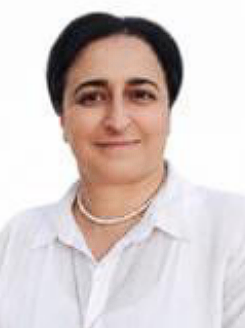
Nigar David Bayramova was born on December 28, 1977. In 1999, she received a bachelor’s degree from the Faculty of Mathematics and Computer Science at Ganja State University, followed by a master’s degree in 2001. She subsequently worked as an assistant in the Department of Mathematical Analysis at Ganja State University. Since 2023, she has worked as a lecturer in the Department of Physics and Mathematics at Azerbaijan State Agricultural University.
-

Rukhsara Vahid Pashaeva was born on July 16, 1992. She completed a bachelor’s degree in mathematics at Ganja State University in 2013 and earned a master’s degree in 2015. From 2016 to 2019, she worked as an assistant in the Department of Mathematics at Azerbaijan Technological University. Since 2020, she has worked as a lecturer in the Department of Physics and Mathematics at Azerbaijan State Agricultural University. She also teaches in the Department of Higher Mathematics at Baku Business University.
-

Terlan Rafiq Khalilova was born on August 10, 1999. In 2020, she completed a bachelor’s degree in mathematics teaching at Ganja State University. In 2021, she began her professional career as a mathematics teacher at Poladli Secondary School in the Tartar District. In 2024, she completed a master’s degree in computational mathematics at Ganja State University. Since 2025, she has worked as a lecturer in the Department of Physics and Mathematics at Azerbaijan State Agricultural University.
Huseynov Zakir Nasib was born on July 2, 1955. In 1980, he graduated from the Faculty of Mathematics at the H. Zardabi Kirovabad State Pedagogical Institute. By a decree of the President of the Republic of Azerbaijan dated October 3, 2006, he was awarded the honorary title of Honored Teacher of the Republic of Azerbaijan. In 2012, he defended his dissertation, “Research on the Performance Indicators of PriorityService Telecommunication Networks,” and received a Doctor of Philosophy degree in engineering. Since November 2020, he has served as Head of the Department of Information Technologies at Azerbaijan State Agricultural University.